
What Is Artificial Intelligence
Artificial intelligence (AI) is technology that enables computers and machines to simulate things people normally do: learning, understanding, solving problems, making decisions, and even creating.
In simpler terms: picture a very well-read assistant who’s absorbed a huge chunk of the internet and can now help you write, answer questions, or generate an image — not because it “thinks” the way we do, but because it learned to spot patterns across an enormous number of examples.
AI-powered applications and devices can recognize and identify objects, understand and respond to human language, learn from new information and experience, and even act independently without human intervention — a self-driving car is the classic example.
By 2026, most AI researchers and practitioners — and most AI-related news — are focused on generative AI (gen AI) — technology that can create original text, images, video, and other content. ChatGPT, Claude, and Gemini are probably familiar examples to most people by now.
To fully understand generative AI, it helps to first understand the technologies it’s built on: machine learning (ML) and deep learning.
Machine Learning (ML)
You can think of AI as a series of interconnected concepts that have developed over more than 70 years.
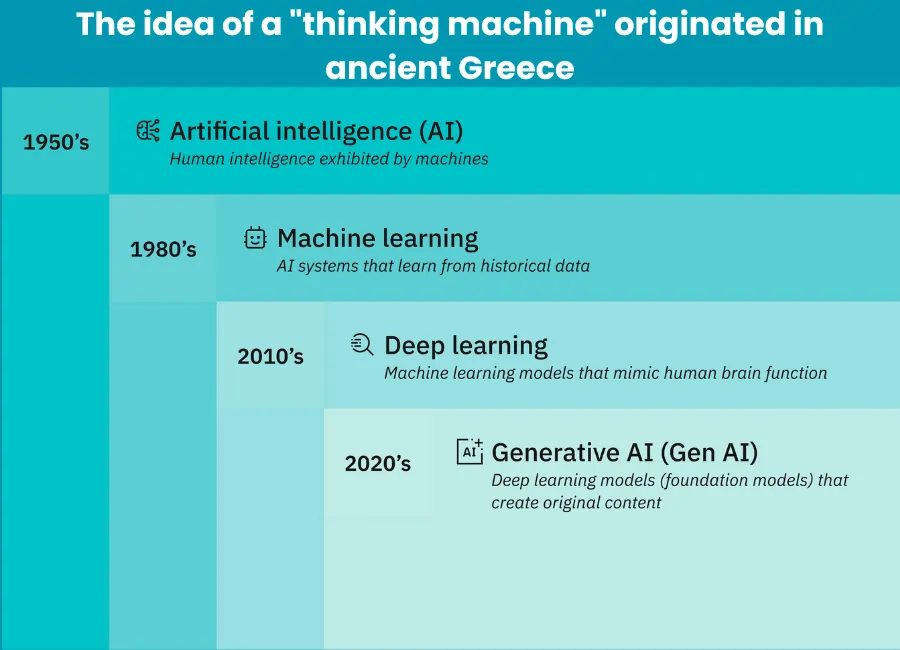
The foundation of AI is machine learning — algorithms that learn from data to make predictions or decisions, without being explicitly programmed for a specific task. Think of it like teaching a child to tell a cat from a dog — not by handing them a list of rules, but by showing them hundreds of pictures until they spot the pattern themselves.
One of the most popular types of machine learning algorithm is the neural network, which loosely resembles how neurons in the human brain are connected — interlinked “nodes” that work together to process complex data and find patterns in it.
The simplest form of machine learning is supervised learning, where people pre-label the correct answers — for example, showing a picture and labeling it “this is a cat” — so the algorithm learns to classify things correctly.
Deep Learning (DL)
Deep learning is a more advanced form of machine learning that uses multi-layered neural networks (“deep” neural networks) to more closely mimic the human brain’s complex decision-making ability.
Unlike simpler, one- or two-layer neural networks, deep neural networks are made up of dozens or hundreds of layers. This lets the system identify features on its own from large, raw datasets — millions of photos, for instance — without a human having to label anything by hand.
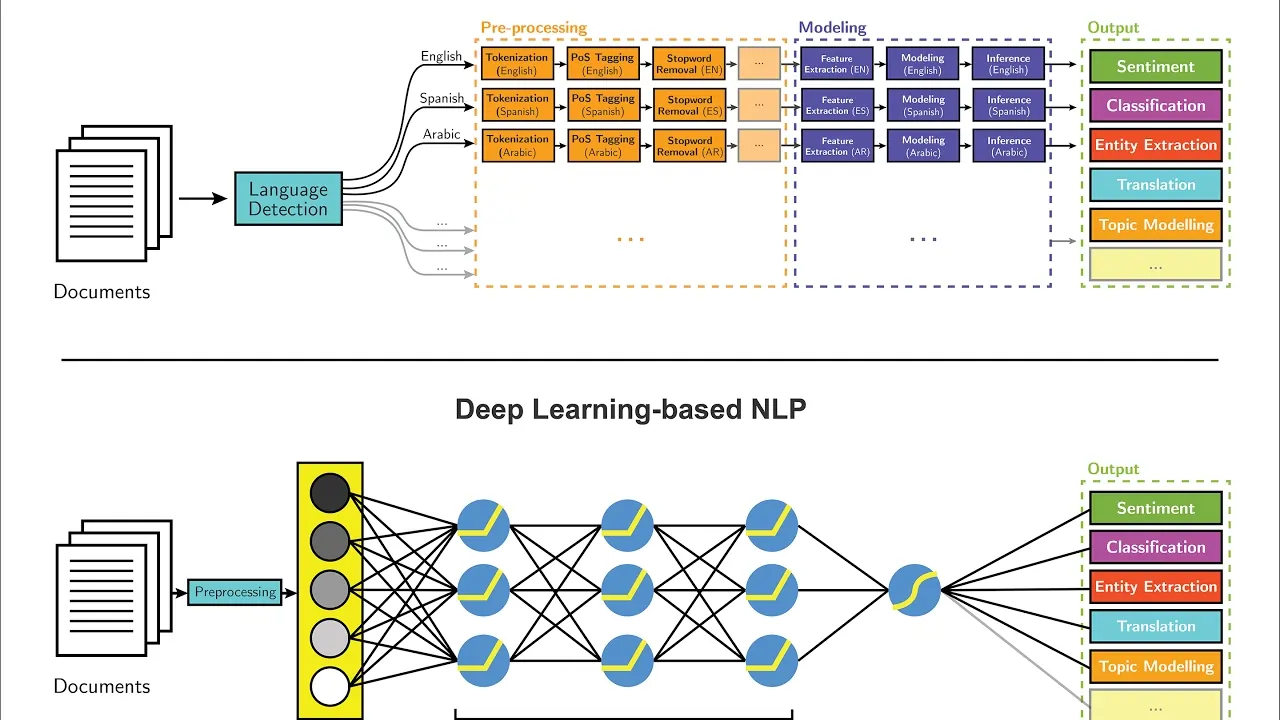
This technique is especially good at tasks like understanding language (NLP) and recognizing images (computer vision). Some form of deep learning sits at the core of most AI applications around us today.
Generative Artificial Intelligence (Generative AI)
Generative AI (gen AI) refers to deep learning models that can create new, original content — long-form text, images, realistic video or audio — in response to a user’s prompt.
In simple terms: the model “learns” from an enormous number of examples of what typical text, images, or audio look like, then produces new work that’s similar to — but not identical to — what it learned from.
Three technical approaches sit behind generative AI:
- Variational autoencoders (VAEs, since 2013) — one of the earliest methods that let models generate multiple different variations in response to a single prompt.
- Diffusion models (since 2014) — work by gradually “cleaning up” a blurry, noisy image step by step until a clear picture emerges. This is the method behind most AI image generators.
- Transformers — trained on sequences (words in a sentence, shapes in an image, frames in a video) and the foundation behind today’s most widely used AI tools — ChatGPT, Claude, Gemini, and Midjourney.
How Generative AI Works: Three Stages
- Training — a base “foundation” model is created.
- Tuning — the model is adapted to a specific task.
- Generation and refinement — outputs are evaluated and the model keeps improving.
1. Training
It all starts with a “foundation model” — a deep learning system that developers train on a massive volume of text, images, or video (often terabytes of data pulled from the internet). The result is a neural network with billions of parameters, capable of independently generating content in response to a prompt.
This process is extremely expensive and time-consuming — thousands of specialized chips running for weeks, often costing millions of dollars. Open-source models (Meta’s Llama, for example) let developers skip this cost entirely.
2. Tuning
Next, the model is adapted to a specific task. There are two main methods:
- Fine-tuning: the model is shown specific question-and-answer examples in the desired format.
- Reinforcement Learning from Human Feedback (RLHF): people rate the quality of the model’s responses — as simple as a human correcting a chatbot’s answer — which helps the model become more useful over time.
3. Generation, Evaluation, and Refinement
Developers regularly (sometimes weekly) fine-tune, test, and refine their AI applications. The foundation model itself, however, is updated far less often — usually about once a year.
Another common technique is Retrieval-Augmented Generation (RAG) — giving the model access to external, up-to-date sources (your own documents, or a live web search, for example) to make its answers more accurate and current.
The Benefits of Artificial Intelligence
AI offers real benefits across industries and everyday life. The most commonly cited ones are:
- Automating repetitive, tedious tasks
- Processing large volumes of data quickly
- Faster, more accurate decision-making
- Reducing human error
- 24/7 availability
- Reducing physical risk in dangerous work
Automating Repetitive Tasks
AI can take over routine, often tedious work — data collection, entry, sorting — freeing people up for higher-value, more creative work.
Better Decision-Making
AI helps businesses make faster, data-driven decisions — often in real time, without constant human involvement.
Reducing Human Error
This matters especially in fields like healthcare, where AI-driven surgical robots, for example, provide consistent precision. Machine learning models also keep improving on their own as they’re exposed to more data.
Constant Availability and Consistency
AI chatbots and virtual assistants are available 24/7 and respond just as consistently every time, easing the load on customer service teams.
Reducing Physical Risk
By automating dangerous work — animal control, handling explosives, deep-ocean or space tasks — AI reduces the need to put people in harm’s way. Self-driving cars, while still imperfect, have the potential to reduce injury risk on the road too.
Where AI Is Actually Used
Customer Service and Support
Companies use AI chatbots and virtual assistants to handle customer questions, support tickets, and order status — with 24/7 availability, freeing up human agents for more complex issues.
Fraud Detection
AI algorithms can spot anomalies in transaction patterns — unusual spending or login locations — letting banks and companies respond quickly to potential fraud.
Personalized Marketing
Based on a customer’s purchase history, AI can recommend products and generate personalized offers in real time.
HR and Recruiting
AI platforms can streamline hiring — screening resumes, matching candidates to job descriptions, even analyzing preliminary video interviews — cutting down on administrative work and time-to-hire.
Writing and Modernizing Software
One of the biggest shifts in 2025-2026 has been in programming itself — AI assistants can now write, debug, and refactor code, accelerate legacy-system modernization, and cut down on errors. For a lot of developers, this has become a daily work tool rather than an experimental novelty.
Predictive Maintenance
Machine learning models analyze data from sensors and IoT devices to predict when equipment will need maintenance — helping avoid unplanned downtime before it happens.
AI’s Challenges and Risks
Fast adoption is necessary to stay competitive, but integrating AI into real workflows comes with genuine challenges.
Data Risks
AI systems rely on datasets that can be vulnerable to data poisoning, bias, or cyberattacks. Organizations need to protect data integrity across the entire AI lifecycle.
Model Risks
Cybercriminals can attempt to steal, reverse-engineer, or manipulate AI models — tampering with a model’s architecture or parameters directly affects its behavior and accuracy.
Operational Risks
Models are vulnerable to “drift” (accuracy degrading over time), bias, and governance gaps, which can lead to system failures or security vulnerabilities.
Ethical and Legal Risks
Neglecting security and ethics can lead to privacy violations and biased outcomes — biased training data used for hiring decisions, for example, can reinforce gender or racial stereotypes.
Shifting Job Markets
Automation is reshaping the labor market — especially routine, repetitive roles — creating a real need for reskilling. Many analysts note that in the AI era, hands-on experience matters more than ever: demand for experienced specialists is rising, while the market for purely entry-level, easily-automated tasks is shrinking.
AI Ethics and Governance
AI ethics is the field studying how to maximize AI’s benefits while minimizing risk and unintended harm. These principles are put into practice through governance systems — frameworks of rules and safeguards that help keep AI safe and ethical.
In 2025-2026, this moved from theory into practice: the EU’s AI Act came into force in stages — in February 2025, the most dangerous practices were banned; in August 2025, rules for general-purpose AI models took effect; and by August 2026, transparency requirements and EU enforcement powers became active — meaning AI regulation is now a real, enforceable rule, not just a statement of intent.
Here are the core values associated with AI ethics:
Explainability and Interpretability
As AI grows more complex, it becomes harder for people to understand how an algorithm arrived at a given conclusion. “Explainable AI” is a set of methods that helps people understand and trust AI outputs.
Fairness and Inclusiveness
Machine learning is, by nature, a form of statistical pattern-matching — but it becomes a problem when it systematically favors one group at another’s expense. Careful data collection and diverse teams reduce this risk.
Robustness and Security
A robust AI system holds up under unusual scenarios — anomalies in input data or deliberate malicious attacks.
Accountability and Transparency
Organizations need clearly defined responsibilities for developing and deploying AI systems. Users, too, should be able to understand how a service works and what its limits are — greater transparency builds greater trust.
Privacy and Compliance
Regulatory frameworks, including GDPR, require organizations to protect personal data. It’s essential to know what data goes into a model from the start, and to build systems that can adapt as regulations and attitudes around AI ethics evolve.
The History of Artificial Intelligence
The idea of a “thinking machine” traces back to ancient Greece, but since the dawn of electronic computing, AI’s evolution has followed these key milestones:
1950
Alan Turing publishes Computing Machinery and Intelligence. Turing, known for cracking Germany’s “ENIGMA” code during World War II, asks: “Can machines think?” and proposes the Turing test.
1956
John McCarthy coins the term “artificial intelligence” at a conference at Dartmouth College. That same year, Logic Theorist — the first AI computer program — is created.
1967
Frank Rosenblatt builds the Mark 1 Perceptron — the first computer based on a neural network.
1980
Neural networks using the backpropagation algorithm see widespread adoption in AI applications.
1997
IBM’s Deep Blue defeats world chess champion Garry Kasparov.
2011
IBM Watson beats human champions on the TV quiz show Jeopardy!.
2016
DeepMind’s AlphaGo defeats world champion Lee Sedol at the game of Go.
2022
The rise of large language models (LLMs) like OpenAI’s ChatGPT fundamentally shifts public perception of AI and accelerates its business adoption.
2024
Multimodal models emerge, capable of taking in and generating multiple types of data — text, image, and audio — at once.
2025
The GPT-5 family launches, merging general-purpose AI and “reasoning” capabilities into a single system. AI assistants become increasingly “agentic” — able not just to answer questions but to carry out multi-step tasks independently. The EU AI Act’s first obligations take effect.
2026
Weekly active users of AI assistants approach a billion. Text-to-video generators (like OpenAI’s Sora) and AI voice-cloning technology become widely accessible — opening up new possibilities and new risks alike, including deepfake fraud. The EU AI Act’s transparency requirements and enforcement powers become active.
“The question of whether a computer can think is no more interesting than the question of whether a submarine can swim.”
– Edsger W. Dijkstra, computer science pioneer
